Okim Taiyangfan Keshi Bingseng Shijian
Gate CrashersThe Okim sun-weed runaway event is the catastrophe that transformed Okim from a rapidly advancing industrial world into a frozen planet beneath a new artificial star. The disaster began as a technological answer to pollution and climate instability, but a reproductive defect caused the orbiting sun-weeds to multiply exponentially. Their growth reduced the sunlight reaching the surface until Okim became a snowball planet, while the failure to remove them left survivors dependent on slow, politically difficult rescue and restoration efforts. In the novel, the event is both a historical explanation for the strange celestial object called the Twinkling Star and a cautionary parallel to other forms of planetary destruction.
Causes and Technological Escalation
Okim had been a pre-nuclear society only a few hundred cycles earlier. Its transformation began when an Assembly survey vessel suffered catastrophic pressure loss in orbit and its crew died. The native population observed the resulting new star, recognized it through telescopes as an artificial object, and rapidly pursued the technology it represented. Within a century, Okim launched a capsule to investigate the survey ship; a research team was living aboard it a decade later, and by the end of that cycle the Okim had landed the vessel. Their technological level and industrial capacity then expanded dramatically.
That acceleration carried demographic and environmental costs. The population doubled within a generation, and energy and resource demands grew with it. The Okim exploited large hydrocarbon reserves and built enormous cities, but industrial pollution destabilized the environment, temperatures rose, and coastal regions flooded. Rather than reduce pollution by accepting a lower standard of living, the Okim sought a technological solution that would preserve their existing way of life.
The chosen intervention was the sun-weed: an enormous membrane orbiting the star, described as a self-replicating, quasi-organic machine. Its purpose was to reduce the amount of sunlight reaching Okim and thereby counteract the effects of industrial heating. For a time, the measure appeared to offer an ideal compromise. The Okim could continue their technological and material expansion while adjusting the planet’s climate from orbit instead of changing their economy on the ground.
The Runaway and the Frozen Planet
The system failed because its reproduction mechanism had not been tested under the combination of low temperature, microgravity, and high radiation found in orbit. The defect, likened by the explanation to a small creature that enters machinery and causes havoc, became catastrophic in the actual orbital environment. Once activated there, the sun-weeds reproduced exponentially.
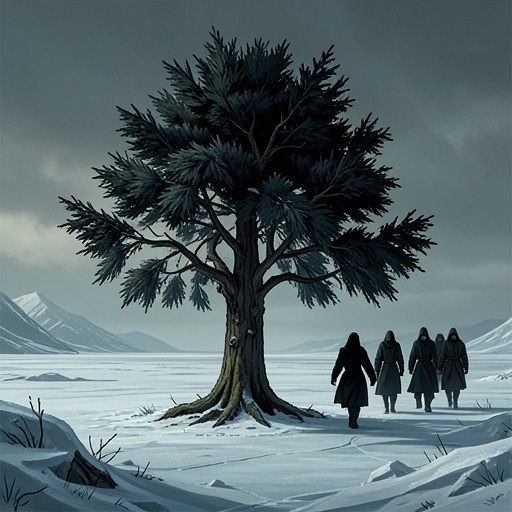
The multiplying membranes eventually created the strange stellar appearance observed by Allison Ridgeway’s expedition as the Twinkling Star. Their growth also blocked enough sunlight to freeze Okim solid. When Jacqueline Dorsett collected a sample, the expedition proceeded toward the planet in the star’s former habitable zone, only to find a world that had become a snowball planet. Its atmosphere contained nearly two thousand parts per million of carbon dioxide, an unsettling remnant of the industrial crisis that the sun-weeds had been intended to manage.
The Okim tried to remove the machines, but the sun-weeds were powered by a modified photosynthetic process. By the time their creators understood the scale of the malfunction, the weeds were growing faster than they could be destroyed. The attempted solution had therefore become self-sustaining: the more the Okim fought it, the more clearly the disaster revealed that their control over the system had been lost.
Survivors, Delay, and Political Failure
The event did not annihilate the Okim entirely. Once their fate became known, the Assembly sent relief vessels to relocate the survivors, but only a few thousand remained. Plans were made to destroy the sun-weeds and place Okim on a path toward recovery. Those plans repeatedly stalled because the weeds proved resilient, the exiled Okim possessed little political influence, and sufficient resources were difficult to secure.
Each interruption made the problem recur. Whenever the restoration effort stopped, the sun-weeds replenished themselves and the crisis returned to its starting point. The disaster thus outlasted the moment of technical failure: it became an administrative and political condition, sustained by limited resources, weak representation, and the difficulty of maintaining attention across many cycles. The frozen world remained not merely the consequence of a past mistake but the visible result of repeated postponement.
The history also forms part of a broader pattern in the novel. The explanation given to Allison Ridgeway connects the Okim experience with another civilization’s decision to delay action until the last possible moment, even while some people continued to claim that the planetary impact was mistaken or fraudulent. The parallel shifts responsibility away from a single malfunctioning device and toward the habits of denial, delay, and faith in technical rescue that allow risks to become irreversible.
Narrative Function and Significance
For the expedition, Okim is first encountered as a physical anomaly: a frozen planet inside the habitable zone of the Twinkling Star. Its condition forces the crew to reconstruct the chain linking industrial expansion, climate instability, orbital intervention, mechanical error, and planetary freezing. The event therefore converts a mysterious landscape into a legible historical warning.
Its contrast with the Lividite destruction of worlds is especially important. The Lividite war machine could deliberately destroy an entire planet by opening a high-space portal through it, rupturing its geology and triggering an apocalypse. Okim’s catastrophe is different in intention and mechanism. It begins with an effort to preserve civilization, yet produces planetary ruin through an uncontrolled technological feedback loop. Together, the two histories show that geocide can arise both from calculated violence and from systems designed to solve an immediate problem without accounting for their wider consequences.
The event also resonates with the novel’s depiction of spectacle and delayed comprehension. The enormous red-hot inverted cone seen from the ground during a later planetary crisis makes planetary danger suddenly visible and terrifying, whereas Okim’s disaster develops through industrial pollution, orbital growth, and administrative delay before presenting itself as a frozen world. The contrast places ordinary technological decisions on the same causal continuum as spectacular catastrophe.
Okim’s fate ultimately gives the phrase “path of least resistance” a grim ecological meaning. The Okim chose the easier political route—preserving their standard of living rather than reducing pollution—and then inherited a problem that became harder to solve at every stage. The sun-weeds were meant to protect the planet from the consequences of progress; instead, their runaway growth made the consequences permanent enough to be seen from space.